ALICE IN MEMORYLAND



ALICE IN MEMORYLAND
. Fiction, 77 minutes
.Written and directed by Annie Molin Vasseur
Collaboration Alisi Telengut
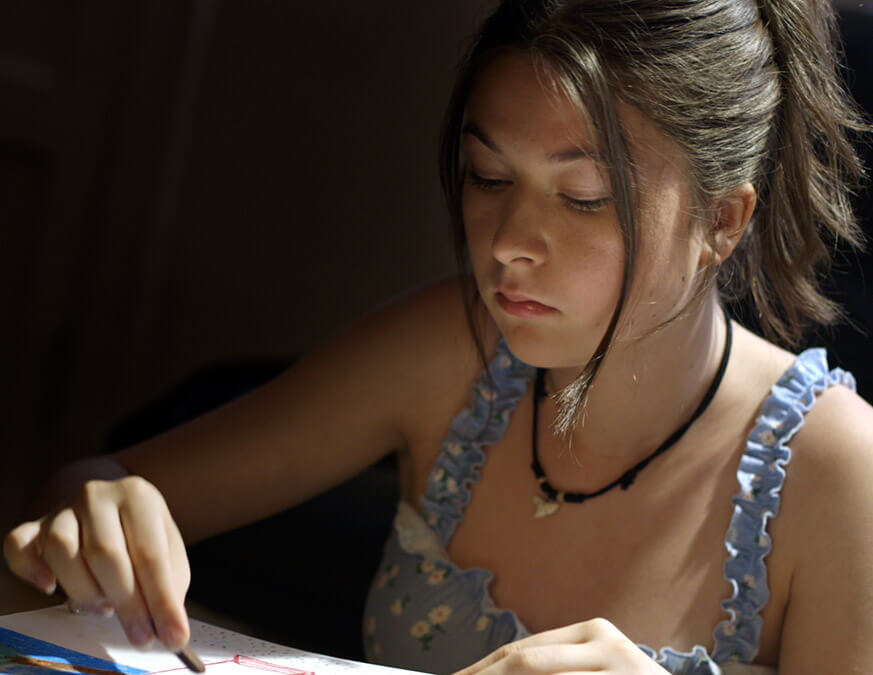
. In the role of Alice: Lili Vasseur
. Music Marc Poellhuber
Voice Rebecca Haéri
. Photography: Christian Rivera (Mongolia), Manuel Codina (France), Bruno Desrosiers (Canada)
. Sound: Anthony Salvo (Mongolia/France)
Sandra Lefebvre (Quebec)
. Editing: Annie Molin Vasseur,
Philippe Vasseur, Pierre Ducrocq and Emmanuelle Boileau
. Production: Annie Molin Vasseur,
Production Manager Gaëlle Goulet-Bourdon and Margaux Ouimet
. Post-production direction: Philippe Vasseur
. Musical direction and sound design Louis Haéri
. Colorization direction Chloé Raimon
. Direction distribution Christelle Barrilliet
(Filming carried out in Mongolia in June 2017, in France in September 2017 and in Canada, in Montreal in July 2021).
PITCH
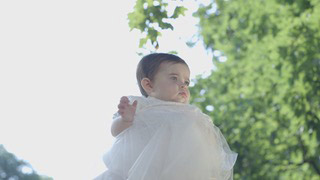
ALICE, a teenager, asks her grandmother to tell her about events in the life of her mother who disappeared when she was little.
SYNOPSIS
Based on family photos, teenage ALICE asks MAMITA, the grandmother who raised her, to recount events in the life of her mother, who disappeared when she was four.
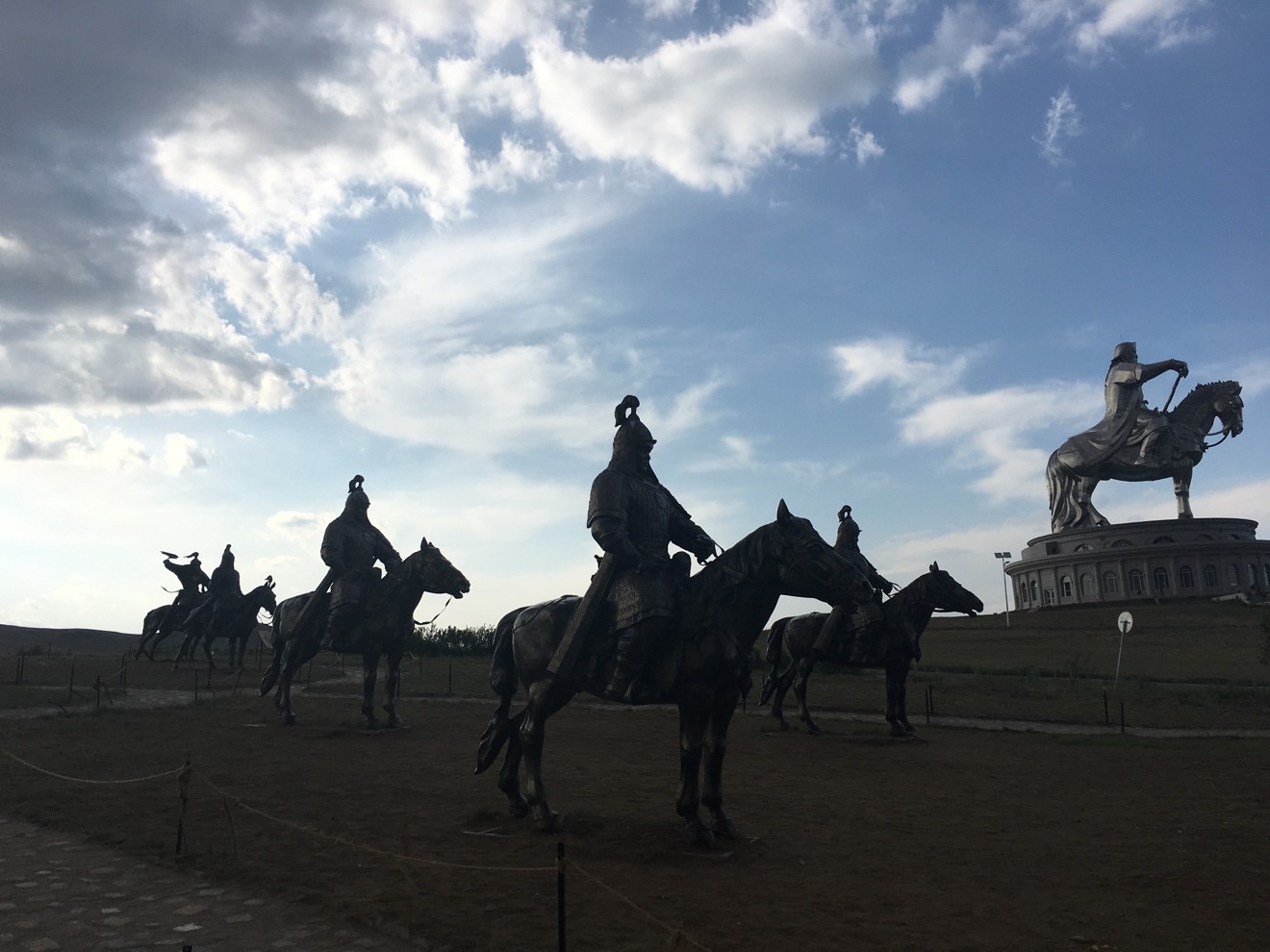
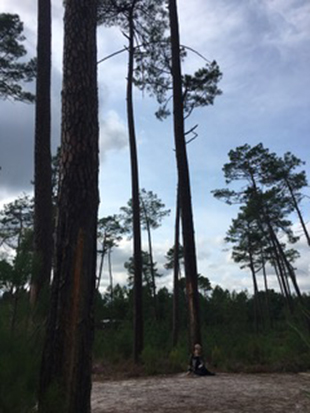
Little by little, under Mamita’s voice, repressed traces emerge in Alice’s mind, revealing certain forgotten faces and places from her early childhood in Paris, the South of France, Mongolia… The memory of her deceased grandfather, PAPINOU, reading to her in the past, joins that of visits to museums when she was little. Key figures and events from different cultures run through her story. For this young up-and-coming artist, the known and the unknown are intertwined in the complexity of living between dream, imagination and reality. A journey down memory lane on the quest for oneself, one’s origins… and the world beyond oneself.

PRESS BOOK
TRAILER
DIRECTOR’S NOTE
Alice in Memoryland. What memory?
Surely, a deep memory linked to the protagonists’ genetics and epigenetics, and to collective memory. What sticks to our skin! Alice has forgotten her trauma from when she was four years old, when her mother disappeared, and an even earlier tragedy. What is the première origin? Is this what Alice is searching for? She doesn’t know what le manque à savoir, this unknown is made of, but it will gradually reveal itself, like a continent immersed in her images: imagination and reality intertwined. Is Time this intertwining of permeable zones where everything that appears is undone and reappears? Or is it a fable erected by conscience, seeking to shed light on the blind spot of all existential anxiety? In my productions, there is un fil rouge, a common thread that which overflows la matière and questions the transcendence of the image, le hors-champ, the off-screen, the black memory emanating from the personal and collective unconscious. For Alice, the quest for the meaning of life is the pivot point.
So how do we bring this invisible off-screen presence to the screen? Some cinematographic processes are used to capture the ghostly reality of the image in the emergence of memory traces. The film’s slow pace underscores the long process of integration into consciousness. The repetition of images belongs to the same unveiling, they appear, disappear and return to visit Alice’s questions. Superimposed shots reveal the overlap between deep memory and recollection. Then, the large number of cultural references in the film, if we want “the full” of the form, signals the incessant occupation of images in our heads, which Alice tries to clarify. This fullness (childhood, museums, and countries crossed) reflects the density of memory. The film’s narration constantly returns to the incessant merry-go-round of the mind between advances and retreat of the traces which shape her thinking. The voice-overs play a major role in the soundtrack, evoking memories such as the grandfather’s readings. In addition, wide shots replace the usual champs/contrechamps: the voices are heard when the faces have disappeared. Finally, the editing of the film reinforces the telescoping of images, places and periods, suggesting the upheaval of l’esprit du temps, its multiplicity of points of view. The film goes beyond realism and moves away from a chronological narrative.
Alice in Memoryland has little to do with Alice in Wonderland, other than to share a poetic universe and a journey through memory. The filmic poem, this plunge into Alice’s consciousness in the throes of adolescence, is a call from being. Poetry is the powerful impetus of an inner world. There is no contradiction here between rational and irrational.
For me, making a film is not about judging or endorsing one’s era, but about looking at and questioning the complexity of one’s time through our sensibility, our reminiscences and our collective consciousness. All that remains is to grasp the form. Has cinema sufficiently dominated technique to decode it and allow itself to return to what was denied to it at its origins: the link to painting, theater and literature… une poétique première, a primary poetics?
I believe that Alice in Memoryland modestly questions our memory at large, this marker of our knowledge and destruction, but also of our potential for development. Will humanity, like Alice, have to move beyond its tumultuous and angry adolescence to become less destructive and more creative? The film poses questions but doesn’t pretend to have any didactic answers. Like a little snail’s slime poetically lodged in Alice’s head, it moves slowly forward, like our species, questioning the limitations of our existence in the face of the inexorable presence of vital forces within us, including those of memory.
Thanks to the production and post-production team whose names appear in the credits, and to all those we met in Mongolia, France and Canada who took part in the film. Their presence marks the film. I’d particularly like to thank Alisi Telengut, because it was thanks to her invitation to go to Mongolia that the whole team made the trip. And with great emotion, I’d like to thank Philippe Vasseur and Lili Vasseur. Before I knew it, this film had become a family saga, even though the events presented are purely imaginary. I dedicate this film to my two children: Martine and Philippe.
Annie Molin Vasseur
A reading by GUY MAGEN:
Le film d’Annie Molin Vasseur est un film dans la grande tradition de l’âge d’or du cinéma français avec Alain Resnais et Chris Marker en particulier, où la mémoire, le thème de la mémoire, la trame de la mémoire… où le tissu de la mémoire en fin de compte suffit à constituer à lui seul un scénario de bout en bout. D’où le titre Alice au pays de la mémoire. En l’absence de souvenirs précis, privés du « vierge, du vivace et du bel aujourd’hui de l’enfance », seul le cinéma pouvait rendre compte de cette existence émoussée de son passé. […] La mémoire représentée par l’eau est faite chez quiconque d’une double vasque. La première pour recueillir ce qui doit être conservé, la seconde pour pouvoir renouveler ce qu’une vie laisse par mégarde échapper du temps. L’eau est la vie et la vie est mémoire. Nous l’avions oublié.
Chez Alice domine le sentiment que le sable du temps, en dépit du flux et reflux en elle de ce qui fut son passé, a trop absorbé […] Sa mère se dissipe de dos dans le lointain, ainsi que dans les contes de Perrault ou de Lewis Carroll. […]
Alice à la vitre dessine une hyperbole où les êtres les plus proches ne se rencontrent vraiment qu’à l’infini. L’Homme réduit et schématise son monde pour le comprendre et mieux le saisir. C’est l’avertissement de Kafka : nous croyons piéger le monde et c’est lui qui nous piège. […] Le réel, où l’absence de souvenir fait une ouate, n’apparaît que dans toute sa brutalité : violence de l’esquisse, sursaut de l’évitement, salut de la lévitation*, comme chez Sartre, échec ou réussite ou comme chez Lacan, obstacle ou rempart. Alice devra choisir de léviter, c’est l’espoir que la réalisatrice lui apporte […] comme pour ces jeunes filles qui, loin d’être précipitées, s’envolent sur la balançoire.
Excerpts from “5 minutes pour comprendre,” by Guy Magen, film semiologist.
*References, among others, to la course landaise.
PRODUCER
 Annie Molin Vasseur, born in France, emigrated to Canada in 1981. Coming from a theater background (actress at the Living Theatre in New York), she became active in the visual arts community in Quebec. In the 1980s and 1990s, she founded the art gallery Aubes 3935 and co-founded the Association of Contemporary Art Galleries of Montreal, and the magazine Etc Montréal. A 2006 graduate of the INIS Film School, she became a director and producer. Among the films she has directed are two feature-length fiction films: The Voice of the Shadow (2013), and Alice in Memoryland (currently being distributed). In 2023, she founded the publishing house AMV édition.
She has published approximately ten books and numerous articles. She has served on the editorial boards of Arcade magazine and Femmes de parole magazine. Her latest book of poetry, Le requiem des mots, was published in 2024 by Écrits des Forges in Montreal. She also pursues her career as an editor, writer, and filmmaker.